DTF printing (Direct to Film) means printing your design onto a film, then transferring it to the garment with a heat press. For a few dozen full-colour event T-shirts, a design packed with detail or a dark garment, it is often the best option. For a simple logo in large quantities, screen printing usually works out cheaper, and embroidery lasts longer on clothing that is worn every day.
How does DTF printing work?
The design is printed in mirror image on a clear film, and a powdered adhesive, melted by the press, then bonds it to the fabric. That intermediate step explains both its versatility, since the same transfer can go onto a T-shirt, a bag or a cap, and its main limitation: the thin layer it leaves on the surface of the fabric.
- The design is printed in colour on a PET film, then covered with a layer of white ink that acts as an opaque base.
- A hot-melt adhesive powder is applied to the still-wet ink, then cured.
- The transfer is heat-pressed onto the garment, then the film is peeled away.
There is no screen to prepare and the number of colours makes no difference: a photographic gradient costs the same to print as a single flat colour. What drives the price is mainly the size of the design. With screen printing, it works the other way round: every colour adds a screen, and with it, set-up costs.
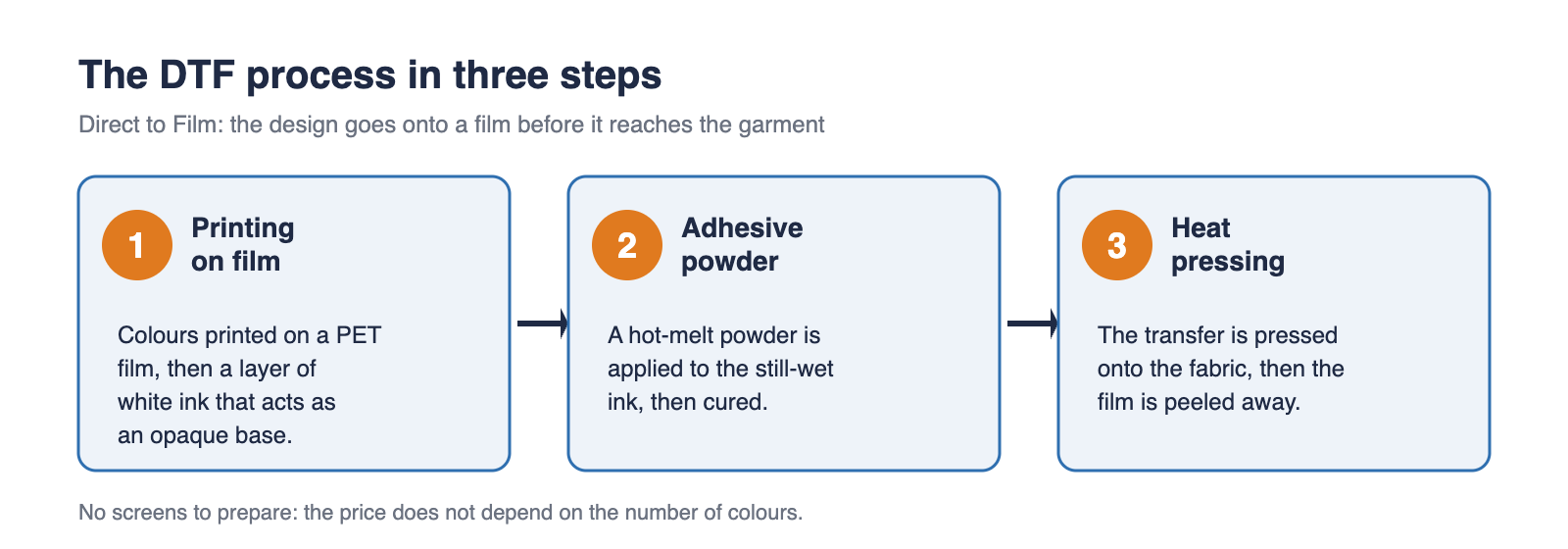
Three steps, no screens to prepare.
Where DTF beats screen printing and embroidery
- Colour and detail: gradients, photos, small text and fine lines stay sharp.
- Dark garments: the white underbase keeps colours bright on a black or navy T-shirt. The pitfalls specific to dark fabrics are covered in our article on printing on dark clothing.
- Short runs: with no screen costs, the unit price drops only slightly as the quantity goes up. And every transfer can be different, which takes care of names and numbers.
- A wide range of fabrics: cotton, polyester and blends, as well as bags or caps depending on the print area. One pitfall with dyed polyester, especially red or blue sports shirts: the heat causes the dye to migrate into the white of the transfer, which turns pink or grey. An anti-migration powder and a lower press temperature reduce the problem, but run a test piece first.
- Minimal preparation: once the artwork is approved, there is no screen to make and no embroidery file to digitise, which helps when the event is getting close.
When something else is the better choice
- The feel: the transfer forms a thin layer on the surface. You barely notice it on a left-chest logo, but you feel it far more on a 30 x 40 cm full-back print, which breathes less than a water-based screen print. For a festival T-shirt worn in midsummer, reduce the print area or switch to screen printing.
- Price on large runs: beyond a few dozen to a few hundred pieces, depending on the number of colours, screen printing costs less per piece on a simple logo.
- Wash durability: good if you follow the transfer manufacturer's care instructions (inside out, 40 °C maximum, air dry, no ironing over the print), but generally a notch below a properly cured screen print or embroidery. See our advice on caring for your customised clothing.
- Some fabrics need a test: water-repellent or coated fabrics, nylon, heavily textured knits. Technical jackets fall into this group: see which printing technique suits softshell fabrics.
- How it comes across: on a polo worn by reception staff or a work jacket, a printed logo looks more like event merchandise than an embroidered one. If the garment represents your brand in front of customers every day, go for embroidery.
DTF, screen printing, embroidery or vinyl: which should you choose?
Three questions are nearly always enough: how many pieces, how many colours, and how often the garment will be washed. The smaller the run and the more colourful the design, the stronger the case for DTF. As the quantity climbs on a simple logo, screen printing pulls ahead. And for a garment worn every day, embroidery outlasts both.
| Criterion | DTF | Screen printing | Embroidery | Vinyl (flex) |
|---|---|---|---|---|
| Ideal quantity | From 1 to a few hundred | Medium and large runs | Any quantity | Short runs |
| Colours | Unlimited, gradients possible | One screen per colour | Depends on thread colours, no photo gradients | Usually 1 to 2 |
| Fine detail | Very good | Good | Limited | Average |
| Dark garments | Very good result | Very good with opaque inks | Very good result | Very good result |
| Feel | Thin surface layer | Soft to thick depending on the ink | Raised, stiffer on the reverse | Smooth layer |
| Durability | Good | Very good | Excellent | Good |
| Typical use | Events, complex designs, names | Team T-shirts and sweatshirts in volume | Polos, jackets, caps | Names and numbers |
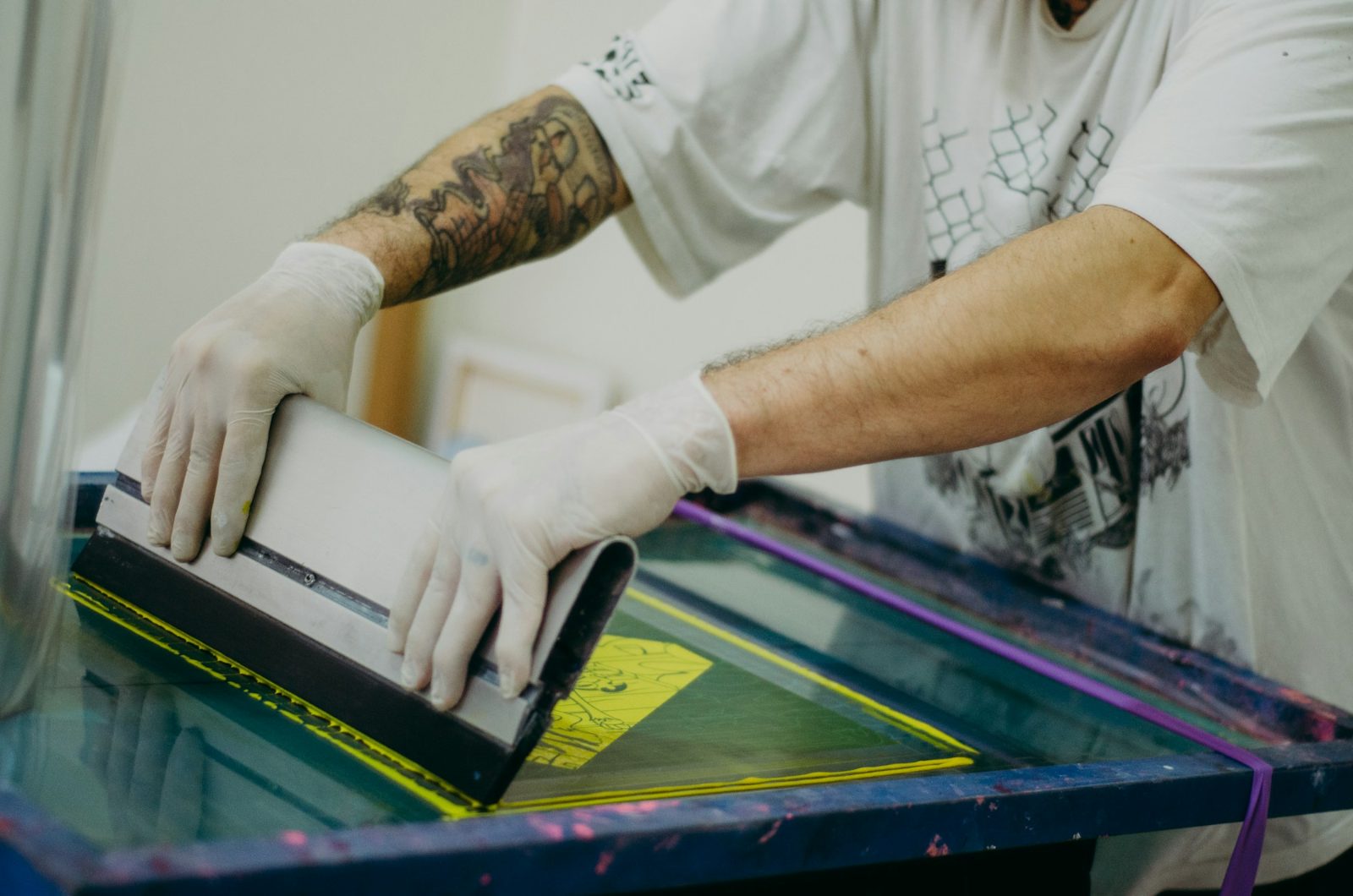
Screen printing still has the edge on large runs of a simple logo. Photo: Deniz Demirci / Unsplash
Four situations we see often
- 30 T-shirts for a trade show, full-colour design: DTF, no question. On a run that short, there is no screen cost to absorb.
- A team of 15 with a name on the back: logo in screen print or embroidery, names in DTF or vinyl. Combining two techniques on the same garment is common practice.
- 500 T-shirts with a two-colour logo: screen printing. At that volume it costs less per piece, and the ink becomes part of the fabric instead of sitting on top as a layer.
- Polos and jackets worn every day: embroidery on the left chest, which copes better with repeated washing. Keep DTF for any design on the back.
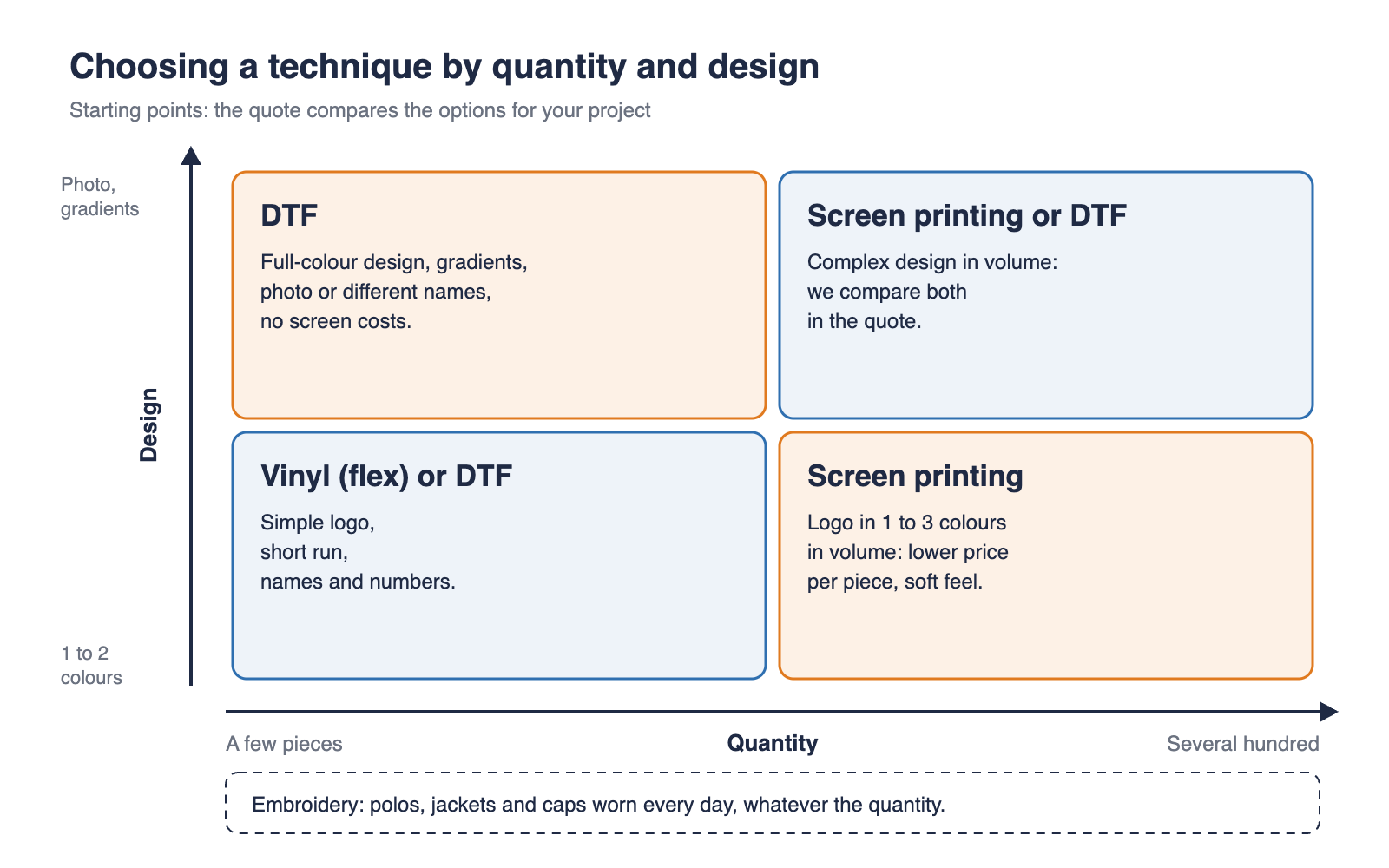
Starting points: the quote compares the options for your project.
The garment matters as much as the technique: a large DTF print on a very lightweight T-shirt weighs the fabric down and makes it pucker around the print. Before choosing from our customisable T-shirts, hoodies and jackets, have a look at our article on fabric weight.
Preparing your artwork file
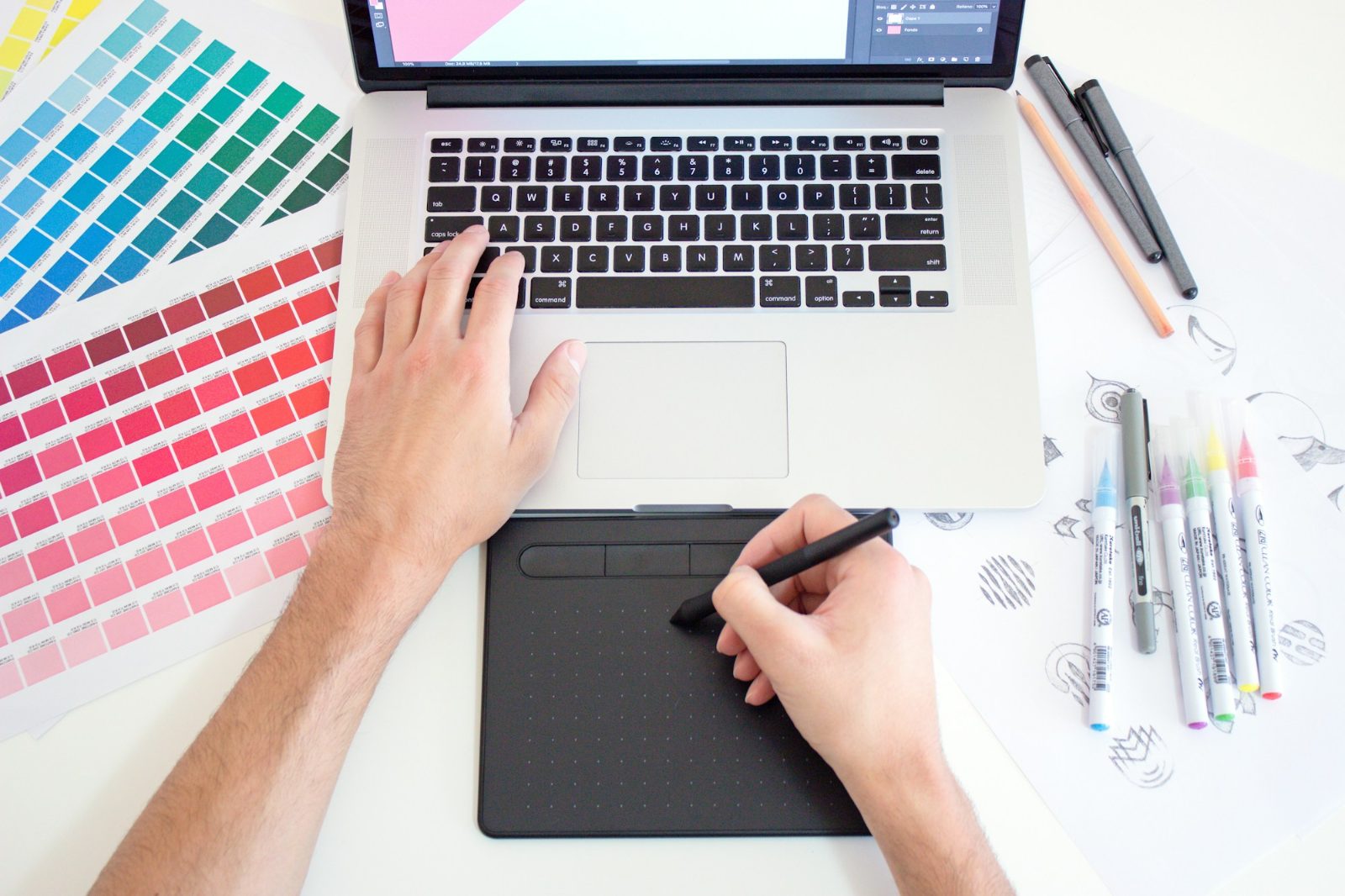
A good transfer starts with a clean file. Photo: Theme Photos / Unsplash
- Send a vector file (AI, EPS, PDF or SVG) or a 300 dpi PNG at actual size, on a transparent background.
- Avoid very thin lines (below roughly half a millimetre) and small isolated elements: they bond less well and are the first to go in the wash.
- Include your Pantone references if the brand colour is critical: DTF prints in CMYK and a shade can shift slightly.
The most common mistake: a logo copied from a website or an email signature, too small and on a white background. File formats are covered in detail in our guide to sending files to production.
Frequently asked questions
Does DTF hold up in the wash?
Yes, provided the transfer was pressed at the right temperature, which only becomes clear after a few washes. Two instructions are often overlooked: wait a day or two before the first wash, and skip fabric softener, which weakens the adhesive. For workwear washed every week, often above 40 °C, embroidery remains the safer choice.
Does DTF crack?
Rarely, if it is pressed properly: the film stays flexible and stretches with the T-shirt. Cracking almost always comes from under-cured powder, too short a press time or a hot tumble dryer. On a very stretchy fabric, such as leggings or a sports shirt, ask for a test: that is where an average-quality transfer cracks fastest.
What is the difference between DTF and DTG?
DTG prints straight into the fibres: the feel is softer, but it performs best on cotton and needs pretreatment on dark garments. DTF goes through a film and works on a wider range of fabrics, polyester included. For a photo on a white 100% cotton T-shirt, we recommend DTG; for polyester or a short run on dark fabric, DTF is the better bet.
Can you use DTF on dark clothing?
Yes, in fact it is one of its strengths. A useful detail: on a black garment, the white underbase is printed wherever there is colour, which makes the transfer slightly thicker. If your logo contains black, we can often leave the black unprinted and let the garment show through: the print is softer and the difference is barely visible.
At what quantity does screen printing become more cost-effective?
There is no single threshold: it depends mainly on the number of colours, since each colour adds a screen in screen printing. For a one-colour logo, screen printing often becomes more cost-effective somewhere between a few dozen and a hundred pieces, later if the design is large. For a design in four colours or more, DTF stays competitive much longer, sometimes up to several hundred pieces.
Your project
Send your logo, the quantity and the garment you have in mind through the express quote form: we compare DTF with screen printing, or embroidery, in the same quote and get back to you within 24 to 48 hours.
Written by Diego Zambrano Braun, founder of INKOO, textile printing specialist since 2010. Last updated: 4 November 2026.
DTF printing: benefits, limits and when to choose it